

Residents seek answers on future of Versailles Lake
Julie Pollock Elliott
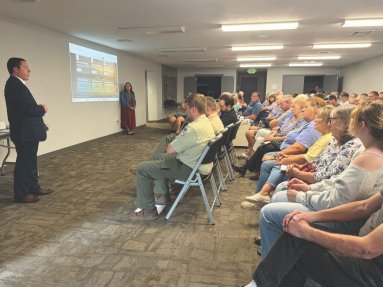
State Representative Alex Zimmerman could be found in attendance at Monday night’s meeting held in Versailles. The room was filled with local residents, DNR and State Park officials.
Residents pressed state officials for answers about the future of Versailles Lake during a town hall focused on sediment, dam repairs and whether a realistic plan exists to preserve the lake.
Approximately 60 percent of the lake is believed to be filled with sediment, significantly limiting recreational use. The dam has also been rated “conditionally poor,” meaning repairs are needed to maintain its future safety.
Brandt Baughman, director of Indiana State Parks, answered questions about the lake and the financial limitations facing the Indiana Department of Natural Resources. Indiana’s 37 state parks operate on an annual budget of approximately $44.6 million.
A 2021 feasibility study estimated the cost of dredging portions of the lake and constructing a roller-compacted concrete spillway at approximately $103.5 million. Baughman said the cost is now estimated at nearly $146 million and could approach $180 million by the time work could begin in another two or three years.
The plan, identified as Option 2 in the study, was recommended by consultants. Baughman said transporting the removed sediment would cost more than the dredging itself.
Residents questioned whether the work could be divided into smaller projects and whether grants, private investments or alternative funding could be pursued. Others asked if state money had previously been appropriated for dredging the lake. Baughman said that, to his knowledge, no money has ever been allocated specifically for that purpose.
State Rep. Alex Zimmerman said state agencies have already submitted their requests for the upcoming state budget. A major new expenditure would likely have to wait until the next budget cycle unless another funding avenue is found.
The $100 million lodge under construction at Potato Creek State Park was cited as an example of a major state investment. Officials explained that the lodge was not funded through the DNR’s operating budget. It was added as a line item to the 2023 state budget by then-Gov. Eric Holcomb.
Zimmerman encouraged residents to contact him, State Sen. Jean Leising and Gov. Mike Braun’s office.
“Positive changes can only be made if contact is made by you to the state officials,” he said.
Alternative Treatment Discussed
Greg Wagner of Napoleon presented a possible alternative involving a product called SchlixX Plus, which is designed to promote the biological digestion of organic sediment at the bottom of lakes and ponds.
Wagner said the product is used throughout the country and costs approximately $3,000 per acre to apply. Versailles Lake could require a second application because of the amount of accumulated sediment.
The initial treatment was estimated at approximately $400,000, with the entire project expected to cost less than $1 million. Results could begin appearing within 10 weeks to six months, although the process could take two to three years.
Baughman said he had only recently learned about the treatment and was not yet prepared to comment on whether it would be effective at Versailles Lake. When asked why it was not considered during the earlier study, Wagner said the option was introduced to officials in 2024.
Decades of Frustration
Residents repeatedly questioned why the lake’s problems were allowed to continue for decades without being resolved. One attendee blamed past management, while others asked whether mature timber from areas of the park that are not regularly used could be harvested to help finance the project.
“This isn’t new. This isn’t from this decade—or two,” organizer Candace Dahline said of receiving phone calls after a story was published first published in The Versailles Republican. “I have lived here. I have tried. It never was handled over 20 years of addressing it,” a resident said.
She said she has received calls from people who have not visited the park in approximately 10 years because of the lake’s condition.
Dahline also called for greater public access to studies and documents concerning the lake.
“We have the transparency because I requested the documents on behalf of the communities,” she said to the State Park Director. “Please keep the transparency and provide them to the public. Please don’t make me request them.”
Dahline said residents and private investors are willing to help begin the process, but the community has felt restricted from fully participating and understanding what is happening.
When she asked what residents could expect going forward, no definite answer was provided.
Safety and Economics Concerns
Attendees asked what would happen to accumulated sediment if the dam were removed. Officials said releasing the sediment could damage Laughery Creek. Residents also questioned how downstream properties and flood zones could be affected by dam removal or a failure during heavy rainfall.
Officials said the sediment has been tested as part of the feasibility study. The water has not recently been tested because the lake no longer has a swimming beach and is not used as a drinking-water source.
Property owners also raised concerns about the effect losing the lake could have on nearby property values. One resident said the lake view was a primary reason for purchasing the property.
Versailles State Park generated approximately $901,000 in revenue during 2025 while expenditures totaled about $1.2 million. Officials said the DNR does not yet have firm numbers showing the park’s broader effect on local tourism but is working to better measure it.
Dahline questioned how much revenue has already been lost because of the lake’s deterioration.
Baughman said Versailles State Park receives one of the highest—if not the highest—ratios of positive visitor comments among Indiana’s state parks. Residents argued that the park’s popularity and regional economic impact should be considered when evaluating the potential return on an investment in the lake.
“Why can’t we dream bigger as the second-largest state park?” Dahline asked.
Lisa Geisler, a nearly lifelong Versailles resident, shared a recent statement from Braun describing Indiana’s state parks as cherished places where families make memories and connect with the state’s natural beauty.
“I have been to a lot of parks in my life, but Versailles State Park, like many others, holds a special place in my heart,” Geisler told The Versailles Republican.
Geisler said one question remains at the center of the discussion: Why, after decades of requests to maintain the dam gates that could have regularly released sediment, has the DNR only now begun addressing the problem?
Residents were encouraged to continue contacting state leaders and ask Braun to visit Versailles State Park.
Although the town hall allowed the community to voice its concerns and explore possible alternatives, the central question—what happens next—remains unanswered.
